

Case Study: Award-Winning Real Estate Team Makes Buyer Research Effortless with an AI Agent
July 31, 2025
In a recent podcast discussion about branding, execution, and expertise, David C. Baker, author of The Business of Expertise, described a “two-room model.” His explanation was part of a strategic discussion on marketing agency positioning, but the lessons are far broader.

First, here is Baker’s model of agency positioning:
There are two rooms in a building: a large room on the right and a small room on the left. There is an exterior door to each room and a connecting door between them. The big room on the right represents execution. The small room on the left is for expertise.
If a new client approaches an agency and enters the execution exterior door, the agency would do implementation work. Many agencies start here. They build the agency, accept this work, and learn.
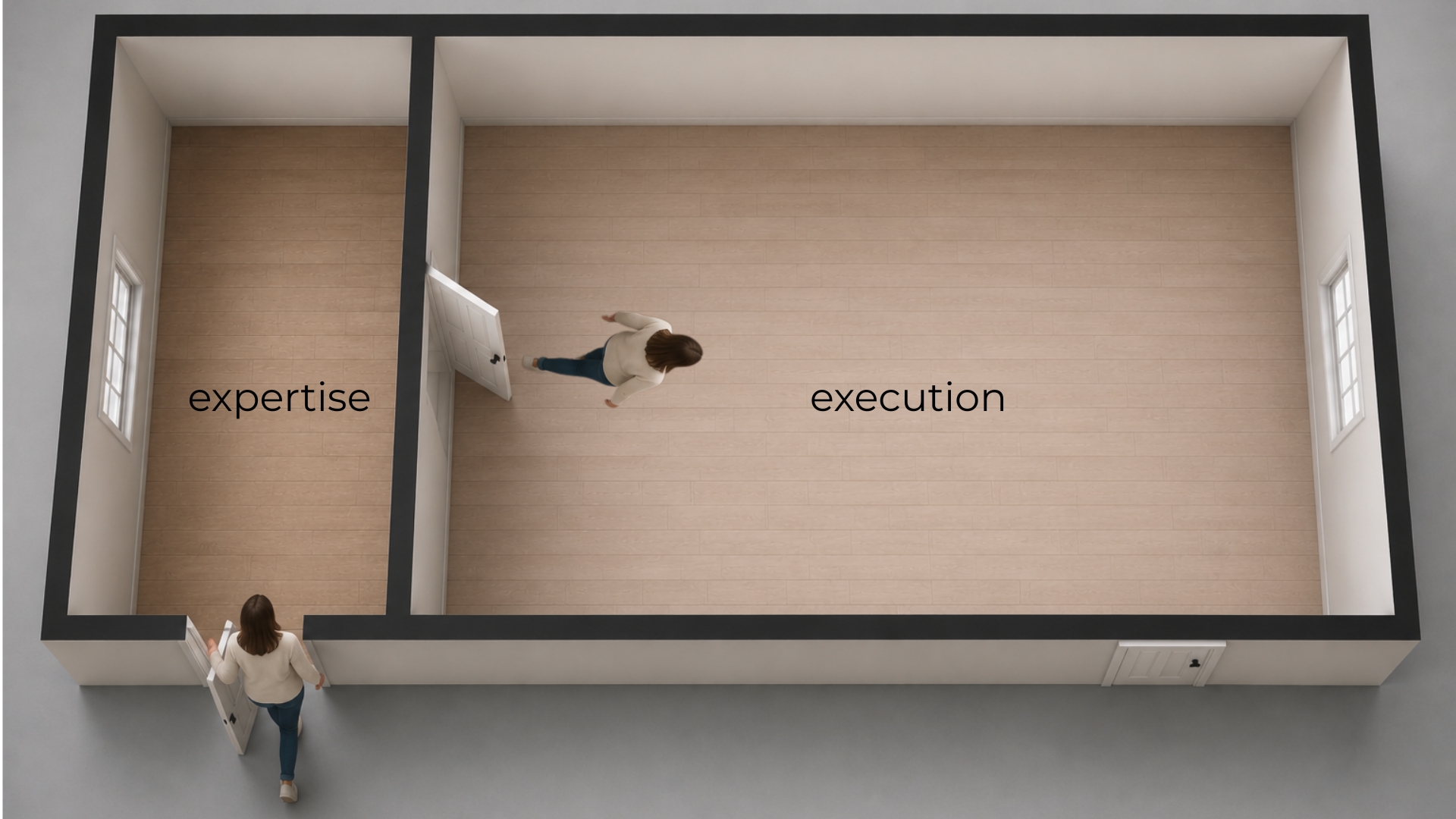
However, what if an agency closed the outside door to execution?
A client would have to enter the agency relationship through the expertise door. It gives the agency a seat at the table, enabling it to help the client identify real problems and develop impactful marketing strategies to address them.
To receive execution services, the client must go from expertise to execution through the interior door. Execution is optional, never required. In other words, a client can utilize an agency for strategic work but choose to execute it elsewhere.
The two-room model and the entry-level job market
Mirroring client work, agencies similarly divide their teams into strategic, client-facing marketers (expertise) and process-oriented marketers (execution). Both roles are hugely important, but now, some execution functions are being done by AI.
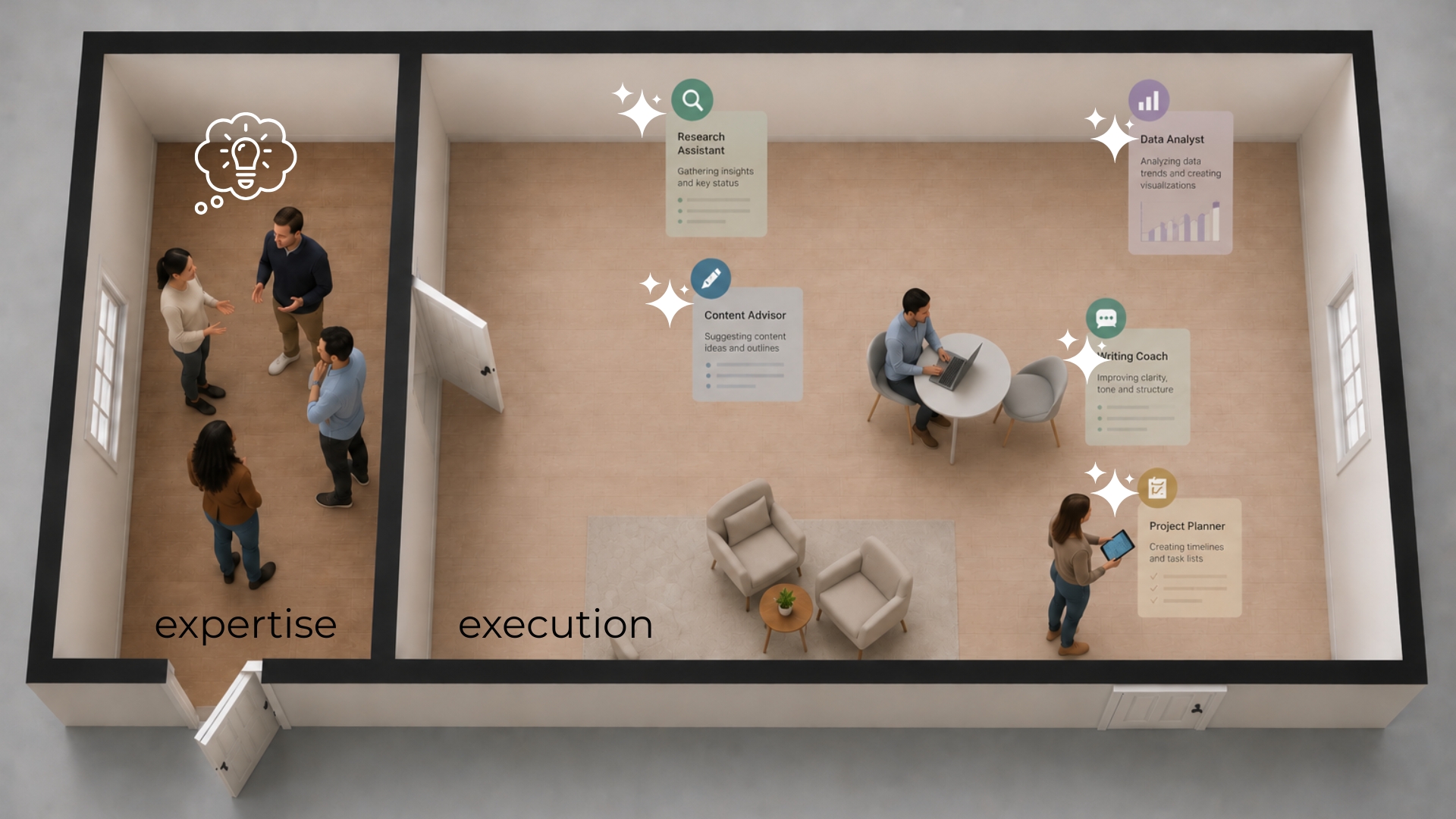
Consider a typical marketing agency.
In the execution room, there could be functions such as:
- Outlining possible ideal customer personas (ICPs)
- Creating target audiences for social media platforms or Google ads
- Reconfiguring marketing campaign assets in different sizes and formats
- Writing short-form copy for social media
- Uploading finished social media posts to social media management platforms
These execution roles are excellent for entry-level marketers, but if AI is used extensively, the net effect is fewer humans in the execution loop.
In the expertise room, marketers collaborate with clients; they become thought partners. For example, marketers:
- Leverage domain knowledge so the business can position itself to succeed
- Align marketing with the client’s short-term and strategic objectives
- Recalibrate channel, platform, and budget commitments based on campaign performance and the client’s goals
- Recommend directional shifts as the environment changes with AI
- Provide guidance on end-to-end digital strategies
Expertise tasks are difficult, demand experience, and are not entry-level. They are more highly valued than execution tasks because the skill sets needed to do them are scarce.
Entry-level job cliff predictions
The 2026 unemployment rate for recent college graduates is 5.6%, compared with 7.2% for the same age group without a degree. In the context of the two-room model, with no exterior entrance to execution, it starts to make sense.
Axios reported that Dario Amodei, the CEO of Anthropic, said, “AI could wipe out half of all entry-level white-collar jobs — and spike unemployment to 10-20% in the next one to five years.” Similarly the American Society of Employers (ASE) outlines a new diamond-shaped human organizational chart in which many entry-level jobs will be replaced by AI. Fewer new hires will be managed by a bulging middle tier, followed by a small management layer on top.
It's worth noting that a recent New York Fed analysis suggests remote-work training gaps, not AI, explain most of the recent rise in youth unemployment. Either way, both factors narrow the entrance to the entry-level door.
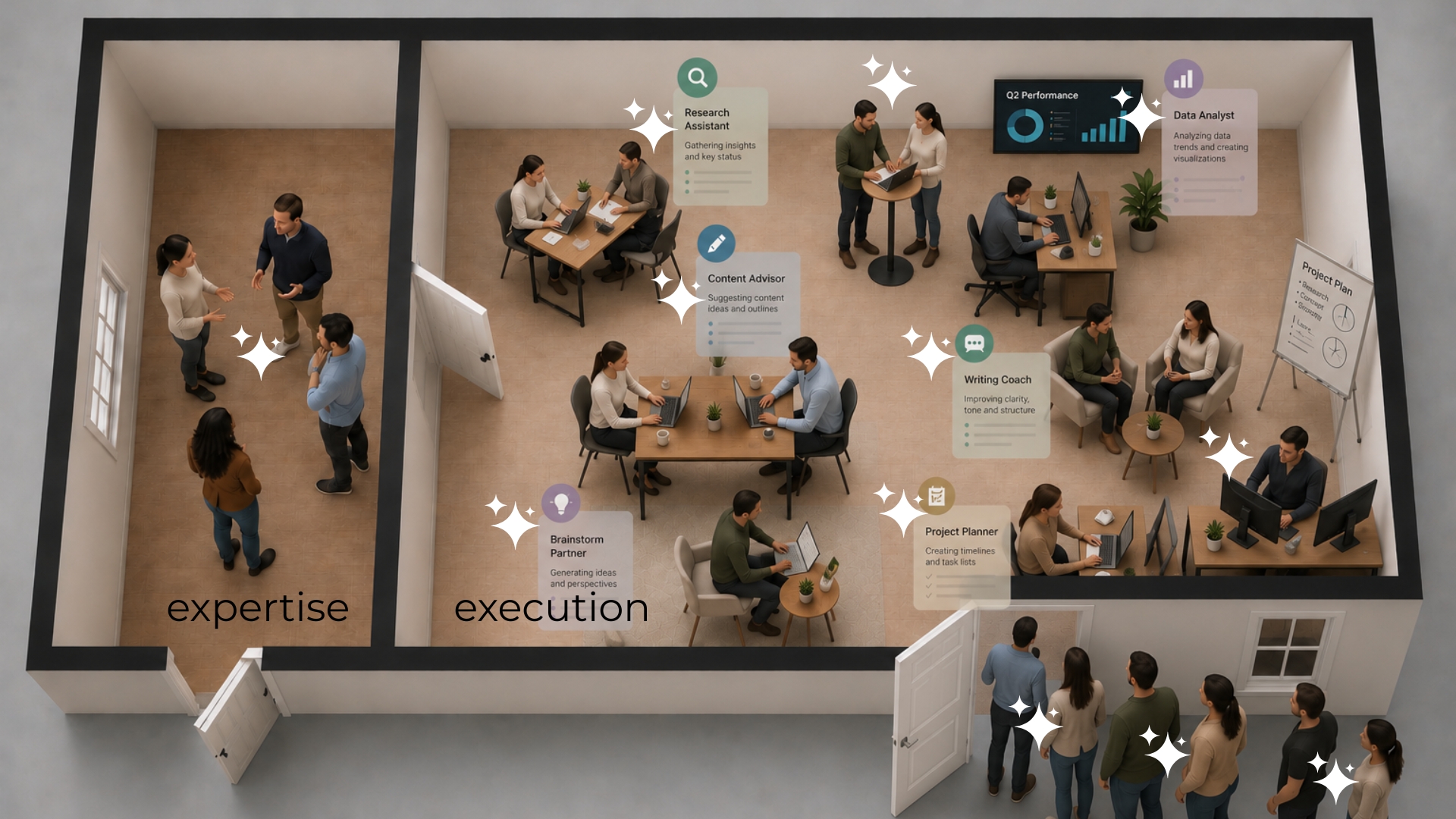
AI will be the on-ramp to entry-level employment
If the job cliff data is temporary, there could be a different scenario that unfolds:
- AI fluency becomes a prerequisite for entering the exterior door of the execution room. It’s an on-ramp.
- The number of execution roles, both for people and AI, multiplies as workers in expertise roles are able to manage more client-facing work while overseeing execution.
- Companies reopen the exterior execution door for entry-level jobs. They have to. Young people graduating from college have a foundation of expertise in their field of study and are digitally proficient enough to tackle AI.
- Higher education moves away from a generalist model and skews towards vertical expertise for students. AI becomes part of the core curriculum because it is a component of vertical expertise. AI is ubiquitous.
I believe in AI as an on-ramp.
As AI weaves its way into organizational workflows, workers, entry-level or otherwise, will raise their expertise by learning to use it. However, without some foundational knowledge in the area where AI is being deployed, AI won’t prove very useful.
David Autor, Ford Professor of Economics at MIT, explained on a recent Possible podcast, “If you’re using AI to do something you really don’t get, you’re kind of out over your skis, and that’s not a good place to be. So, that’s why it’s a good collaboration tool because it’s complementary to something you know about….”
In time, which door graduates enter first may depend less on companies and more on how ready they are to walk through it. How young people choose to acquire the expertise and AI fluency needed to enter either exterior door in the two-room model will shape the landscape of schools and universities for decades to come.
h/t
JUST Branding podcast, S07.E09: “From Execution to Expertise with David C. Baker,” June 7, 2026, hosted by Jacob Cass and Matt Davies
Possible podcast, “David Autor on AI’s impact on jobs, expertise, and labor markets,” July 2, 2025, hosted by Reid Hoffman and Aria Finger


